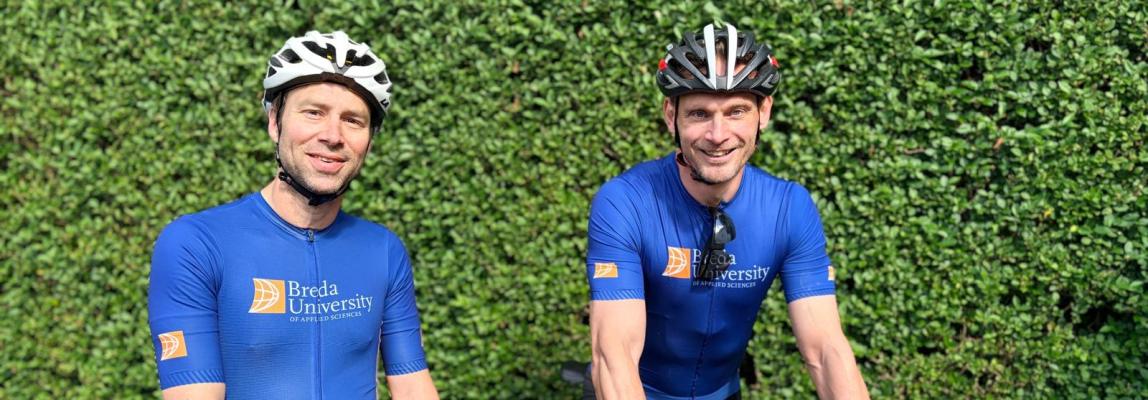
We have ‘urban space’ in common
06/03/2026 - 15:48

- Stories
Paul: ‘It’s a great idea to give us, as researchers, a chance to have our say in the Alumni Newsletter. For many alumni, quite a lot has changed at NHTV slash BUas since they graduated. I’m thinking of myself, for instance – a Verkeerskunde (Traffic Engineering) alumnus from the class of ’97. Perhaps many graduates still think of us as an educational institution, but there’s so much more going on.’
Hans: ‘There’s a remarkable amount of research activity at BUas, and I’ve noticed that students and alumni are keen to get involved. That’s something we want to develop even further.’
Paul did the Verkeerskunde bachelor’s programme at NHTV (now BUas), so I am curious about how after that, he ended up in the world of research. Hans was a student at Erasmus University and worked as a researcher at the Netherlands Organization for Applied Scientific Research (TNO) for years. I’d like to ask him why he chose to work at a university of applied sciences like BUas.
First, Paul.
‘After my studies at NHTV, I worked as a consultant at Berenschot, where I did research into traffic management issues. I attended a master’s programme in Urban Geography in Utrecht and afterwards, I worked as a researcher at the PBL Netherlands Environmental Assessment Agency. At the time, I was already working on the theme of urban liveability and accessibility, at the intersection of spatial planning and traffic management. In 2009, I joined NHTV as a researcher in Ineke Spape’s team, and in 2015 I became a professor by special appointment (bijzonder lector) in Mobility and Space, a collaboration with the Province of North Brabant. And oh yes, I almost forgot, I was also working on my PhD at Delft University of Technology at the time. I was conducting research on the relationship between urban development and travel behaviour. And so now I am a professor in Urban Mobility Planning.’
And Hans?
‘I studied Business Studies in Rotterdam. My PhD research was about urban logistics. What I enjoyed most was practical research, and I thought, where would be the best place to do that? That turned out to be TNO in The Hague. The field of research I work in – urban logistics – was still relatively unexplored at the time. And it continues to evolve; there’s always something new happening, which is what keeps it captivating. I was given the opportunity to start working part-time at BUas in 2019. Since 2025, I have been working full-time for BUas as a professor of Smart Cities & Logistics. I am very keen to bring the worlds of logistics, mobility and urban planning together, and I thought, if it can be done anywhere, it’s here at BUas, where we have brought everything together under one academy.
Paul has been involved in conducting research for longer (than Hans thought).
And Hans has been engaged in the theme of logistics for longer (than Paul thought).
And both of them want to bring the world of one of them (mobility and urban planning) closer to the other’s worlds (logistics). How does this integration of your fields of expertise work in practice?
Hans: ‘It’s a challenge.Students tend to choose Logistics, or Urban Planning, or specifically Mobility (formerly Traffic Management, ed.). They don’t opt for a combination. And yet, it is good to bring everything together in the curriculum. I recently spoke to someone at the local council, with whom I had worked on a project, and they said, “I only now realise that it is useful to include logistics in spatial planning right from the start”.’
Paul:‘So we need to facilitate that more in our education. Adapt our curriculum even further to that end. And, in doing so, we also need to link education more closely to research, and vice versa. At BUas, there are plenty of opportunities to make that combination work. Researchers working with us on projects also engage in teaching. We teach courses ourselves. It’s not just about knowledge, but also about practical skills. If you conduct research yourself, understand the issues and write reports on them, you can guide students better. We also develop modules for teaching, for example on research methods. You can learn that from a book of course, but practical research actually works a bit differently.’
After all, that is what we in Europe want to be the best at, as BUas, in practical research.
Hans: ‘Exactly, and in such a manner that businesses and organisations can benefit from it straight away. At a university, practical research is also carried out – for example, working on an innovation or method – but usually not specifically for a company. To be perfectly honest, working on something just because it might be applicable somewhere at some point doesn’t give me any energy. At BUas, I work very specifically on an application in the professional field. I did the same at TNO, so I’m bringing that experience with me.’
Paul: ‘As a university of applied sciences we are, more than research universities, focused on knowledge transfer; knowledge must be put into practice; it must offer concrete opportunities for action for businesses, organisations, and for our alumni too.’
So, as professors, you’re all conducting practical research with your own teams. But you’re not sitting here together for no reason, of course – where do you find common ground?
Hans: ‘We find common ground in urban spaces. That sounds simple, but it isn’t. I always use the example of going shopping. Suppose you go to the supermarket to do your shopping, by car; that part falls under Paul’s remit because it concerns travel behaviour in the city. If you have those groceries delivered to your home, then strictly speaking, it falls under my remit because then we’re talking about a logistics business process. But we don’t want to be that strict about it.’
Paul: ‘Because eventually, of course, it’s all about the city’s quality of life and accessibility. You have to strike a balance between the two. And that’s something we need to do together. To improve accessibility, you could just roll out the tarmac of course, but that doesn’t benefit a city’s quality of life. And if you make a city centre low-traffic or even car-free, accessibility – and with it the logistics process, such as supply chains – comes under pressure.’
Hans: ‘Within spatial planning, logistics is just a minor element in practice. In that respect, we sometimes suffer a bit from Calimero’s Syndrome. “Just include us in those spatial plans right away,” I find myself saying, but the problem is that a logistics specialist doesn’t think as far ahead as a spatial planner. So we haven’t quite found common ground on that yet.’
But you have found some common ground in a joint research project?
Paul: ‘That’s right. We’re still in the planning phase, so we cannot say a lot about it yet, but we’re surely going to work together. The topic will be the vital city. For example, how does the car-free city centre – part of Mobility – relate to the zero-emission zone – part of Logistics? But it’s also about research into what are termed interchange points; hubs where you switch between modes of transport – think of car parks where you can pick up a bike. What works and what doesn’t. And what does urban logistics need?’
Hans: ‘Especially that last aspect, what does logistics need ;) Seriously though, this is about more than just logistics and mobility. It’s primarily about the quality of life in the city of the future, so we’ll also be seeking to collaborate with, for example the Academy for Leisure & Events. We want to create great crossovers, exactly as we envisage them in our BUas-wide research vision.’
And how do you want to engage alumni and students in them?
Paul: ‘Yesterday I organised a webinar in which students presented their research into new districts in Prinsenbeek and Roosendaal, 40 new apartments, complete with a schedule of requirements. It was a presentation for commissioners in the industry, among whom some of our graduates. I envisage such a construction. One that brings everything together.’
Hans: ‘And then we need to bring in the students of Logistics too, because what happens if all those new residents move in on the same day? Where will those 40 lorries go? It’s often forgotten, but it’s yet another example of how one thing can’t exist without the other.’
Paul: ‘I’ve just been thinking, we could easily cover that bit about logistics in our International Urban Redevelopment minor. Hang on, I’ll just jot that down.’
Hans: ‘It might be a good idea to ask the alumni in that newsletter what they felt was missing from their study programme, looking back, as regards the integration of our fields of expertise. Then we can take that into account.’
That appeal has been made, and Paul adds:
Do you as a Built Environment or Logistics graduate (formerly: Urban Design, Logistics and Mobility, or prior to that: Spatial and Urban Planning or Traffic Management), and you have ideas for cross-domain collaboration or research, or if you have any specific, practical research assignments, please let us know via [email protected].
Interview: Maaike Dukker-‘t Hart