More focus on people
11/26/2026 - 11:12

- Stories
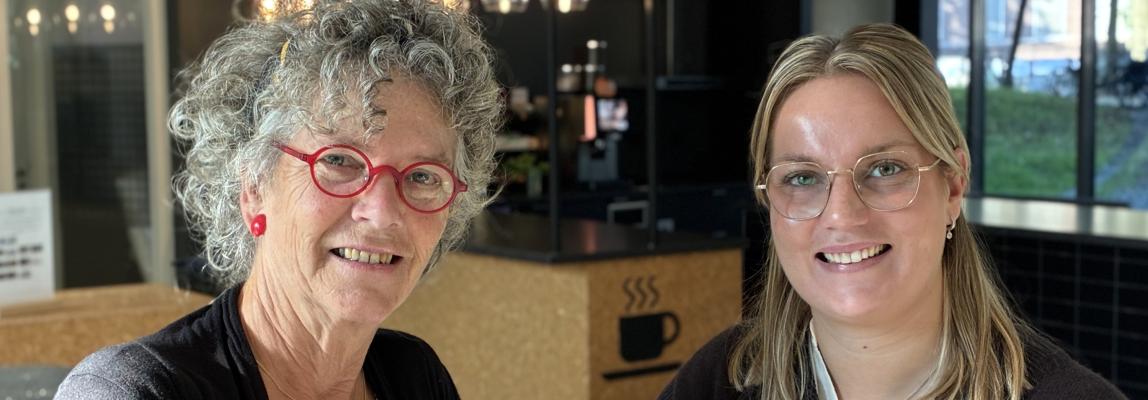
In my view, Danique is the new Ineke, I heard someone say 😉
I’m very curious what you think of that yourselves.
‘Well, I wouldn’t put it that way,’ says Danique, looking a little startled. ‘I mean, Ineke has been active in the Dutch mobility and spatial planning profession for years, and I’m nowhere near that stage yet. I’ve learnt a lot from her, and I’d like to make my own contribution to the field.’
Ineke studied traffic engineering at what was then called the Verkeersakademie Tilburg (Traffic Academy Tilburg), one of the predecessors of BUas. She also studied at the Rheinisch-Westfälische Technische Hochschule in Aachen, where she earned a master’s degree in ‘Stadtplanung’. At NHTV, and later BUas, she spent many years combining both fields as a lecturer and professor at this intersection – Integrated Sustainable Urban Mobility Planning – as well as in her work for her own consultancy firm specialising in living environments and spatial quality.
‘To be honest,’ says Ineke, ‘I’ve only been gone from BUas for a month and I already can’t imagine how I ever found the time for teaching. I don’t think I could do it anymore, I’m far too busy! And that’s with all sorts of new activities (she says with a laugh): just two weeks ago, I joined the board of the Nederlandse Watertoren Stichting (Dutch Water Tower Foundation).’
Okay, so what made you decide to do something like that?
‘I spent 25 years with SOAB (her own company, ed.) in a water tower in the Belcrum district of Breda, so I know how it works for other owners of a nationally listed building like that.’
Let’s first go back to your teaching for a moment. What are you most proud of when you look back?
‘FreshBrains, an educational concept I developed in 2012. It’s still in use today. Working side by side with students on location for full five days, eight hours a day, is very different from spending five hours a week on campus over the course of eight weeks. It means performing under pressure and coming up with a solution in a short space of time for a real client who grappling with a concrete problem. The concept was born out of necessity when we were given an assignment in London. Ideally, you want to go there at least twice, once at the start to gather input and once at the end to present the results. That adds up to a lot of travel and hostel costs, and it isn’t very practical either, so I went looking for a different format, and that’s how the FreshBrains Week came about.’
‘But there’s more, you know,’ Ineke continues. ‘For instance, I’m also proud that, right at the very end, I got to teach in China. It opens your eyes. You have a bit of an idea of what it’s like, but actually experiencing it is something else. The academy has been doing this since 2019: two weeks of teaching at the Anyang Institute of Technology, twice a year. In terms of technology, they are further ahead in our field, but not in their thinking about how space is used and designed. They buy that expertise on public space from us, as the Chinese tend to do with so much else. Here too, the idea is to combine lectures with a project, for example on how urban design can influence and change people’s behaviour. What really helped was that we had brought some of our students along.’
You’ve now left the Academy for Built Environment & Logistics. Is there anything you still wish you’d had the chance to do?
‘Bring back the good elements. I’d like to reintroduce a second placement in the curriculum. And I would do away with competency-based thinking, because I genuinely believe we’ve gone completely overboard with it. If we’re not careful, students will soon be doing nothing but evaluating themselves, and that’s not what the industry is looking for. I’d like to give more room to subject content again. Too often, students don’t understand what they are working on. Here’s a quick example: we discussed a case with 70% slow traffic, meaning pedestrians and cyclists. I asked whether that was a lot, and the students had no idea, they clearly lacked some essential subject knowledge. Do you understand what you have to do with that 70% in your mobility strategy, I asked. More blank looks.’
So I don’t really need to ask: what do you hope Danique will take on?
‘No, that’s entirely up to her! In her own way. I was headstrong when I started out too. Surrounded by old white men, I probably shouldn’t say that, but it was true.’
‘Thankfully that’s not the case anymore,’ Danique laughs.
You were taught by Ineke, weren’t you?
‘Absolutely! And Ineke was my placement supervisor when I was in Berlin. We had really good discussions, and she was, and still is, very approachable. It was always my dream to work here (at BUas, ed.), and I wanted to be just as accessible to students as Ineke. I’ve learnt a lot from her: how to come up with fun teaching methods, how to spot opportunities and how to build on them. Like Ineke, I’m not a fan of lectures where someone stands there talking for an hour or more. I’d much rather engage students in conversation or let them experience things for themselves.’
However content-heavy lectures may be?
‘You can get the content across in other ways, too. In that respect, Ineke is an atypical lecturer (she said so herself: headstrong) who would rather not stand in front of the class, but wants students to experience something from or in professional practice.’
And is that how you go about it too? You started teaching fairly soon after your degree, didn’t you?
‘I worked for two years as a Mobility & Spatial Planning consultant at Goudappel, and I also did a Master of Science in Business Administration at Erasmus University, I was already teaching by then. I try to bring as many real-world examples as possible into my classes.’
‘When I started in education, you had to have at least five years of work experience,’ Ineke remembers, ‘but that was still back when everyone worked in education full-time. Nowadays it’s often combined with a job or a business of your own, which brings in interesting case studies and connections. Combining consultancy practice with teaching means you always stay up to date as a lecturer.’
‘I combine teaching with research,’ Danique adds. ‘I’m currently working on a research project on Inclusive Mobility. That combination makes it fun and also provides new content for my classes. I’m now preparing the courses I’ll be teaching in China on this topic.’
So you’re going to China as well? In that respect, you’re following in Ineke’s footsteps?
‘And in other people’s, too. Every spring and autumn, four BUas lecturers go to Anyang. Last year, for the first time, students also went along as teaching assistants.’
‘I’m really curious to hear how you’ll find it,’ says Ineke. ‘It’s quite intense, teaching from 8 am to 6 pm. And as I’ve already told you, students on the rural programmes don’t get to choose which programme they’ll study – that’s decided by the government.’ (seriously!?) ‘And, of course, that affects their motivation. Out of every 100 students, only three or four end up in the kind of job we train them for, working for a government body or an agency.’
‘Absolutely everything starts from the collective,’ says Danique, drawing on the experience of other lecturers who have taught there, ‘and if you ask students, ’So what do YOU think?’, you’re met with silence. So I’ll have to approach my teaching differently. At BUas, I would put the group to work; in China, the chalkboard still goes down well, so I’ll use that. I’ll invite students to come to the front and write their own ideas on the board, hoping that a kind of mind map will gradually emerge.’
‘Good approach,’ says Ineke. ‘They’re wonderful at drawing!’
‘Like Ineke, I enjoy taking on new challenges,’ says Danique. ‘For example, I recently teamed up with others to record a series of podcasts, which was great fun. I had no idea what to expect, and then I was suddenly told it would go live straight away, ehm, okay. But you know what you’re talking about – how we can better align education with the professional field, and issues in mobility – so it actually went quite well. My parents said I sounded just like I always do.’ (laughs) ‘We made the podcasts in the run-up to the National Traffic and Transport Congress, which is being hosted this year by the MRDH (the Rotterdam The Hague Metropolitan Region, ed.), where Ineke is a member of the board.’
‘And where we could do with some fresh blood,’ says Ineke, ‘perhaps that is something for you?’
Ineke just keeps going, and closer to home too, I noticed. Her street was named ‘The Most Just Street in the Netherlands’ this year.
‘The evening before I left for China, I managed to send an email between the soup and the potatoes to submit the Teteringsedijk redevelopment project for this award. And in China, during dinner, I got a phone call telling me that our street had won. I was involved in this project as a resident, but I also came with a well-stocked professional toolkit, and I shared and used my knowledge. For example, I ran a survey and managed to turn residents’ resistance to paid parking into support. It’s now a bicycle-priority street with plenty of greenery and room for walking and cycling.’
Just so I can picture it, what do you mean by just?
‘A juster distribution of space, with attention to people.’
‘That’s mainly what I want to add,’ Danique concludes. ‘Everything used to have to be functional first; now there’s far more attention for people. More focus on people: that’s the added value I want to deliver, to come back to where this story started.’
A great challenge awaits her in China!
If you’re reading this story, Danique will already be back from China. Curious about her experiences? Or is there something else you’d like to share? Feel free to drop her a message ([email protected]).
Interview: Maaike Dukker-’t Hart